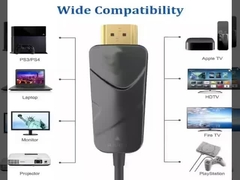
Brief: From concept to demonstration, this video highlights the evolution and practical outcomes of the H.265 HDMI Video Encoder. You will see a detailed walkthrough of its professional HD audio and video encoding capabilities, including how it streams via multiple protocols like HTTP, RTSP, RTMP, and ONVIF. Learn how this cost-effective device integrates into systems for live broadcast, IPTV, and streaming media servers, with insights into its dual-stream output and compatibility with platforms like YouTube and Facebook.
Related Product Features:
Supports H.265 and H.264 video coding for high efficiency and quality.
Features dual video streaming output via HTTP, RTSP, RTMP, UDP/RTP, and ONVIF protocols.
Enables live streaming to platforms like YouTube, Facebook, and Ustream with ease.
Offers a 1000M network interface in full duplex mode for reliable data transmission.
Allows customizable resolution and image parameter settings for flexible deployment.
Includes web-based management interface with support for remote configuration and upgrades.
Supports CBR and VBR rate control from 16Kbps to 12Mbps for optimized bandwidth usage.
Compatible with AAC and G.711 audio coding formats for clear sound quality.
FAQs:
What video input resolutions does the H.265 HDMI Encoder support?
The encoder supports a wide range of resolutions including 1080P, 1080i, 720P, and custom resolutions like 1600x1200, 1280x1024, and 1024x768, making it versatile for various HD video sources.
Can this encoder stream to multiple platforms simultaneously?
Yes, it supports dual-stream output, allowing the mainstream and secondary stream to be pushed to different servers or platforms such as YouTube, Facebook, and RTMP-based services concurrently.
How is the H.265 HDMI Encoder managed and configured?
It features a web-based interface available in English and Chinese, enabling easy configuration, remote management over WAN, and one-key factory reset for simplified maintenance and setup.